So, what exactly is AI-powered content creation? Think of it less like a robot taking over your job and more like having a brilliant co-pilot. It’s the process of using smart tools to help generate, or even automate, the creation of all kinds of content—from blog posts to images and even audio.
It’s not here to replace human creativity. Instead, it acts as a super-powered assistant that can research, draft, and brainstorm ideas at lightning speed.
Unlocking Creativity and Efficiency with AI
Forget the sci-fi fantasies of AI replacing artists and writers. The reality of ai powered content creation is far more practical and collaborative. At its heart, it’s about working with intelligent tech to shatter creative blocks, get rid of boring tasks, and produce fantastic work faster than ever before.
If you're just starting out, it helps to get grounded with a comprehensive explanation of AI generated content to understand what it is and what it isn't.
This technology is already a game-changer for marketers, writers, and businesses. Instead of staring at a blank screen, you can have multiple drafts, outlines, or headlines ready in just a few seconds. This frees you up to do what you do best: refining the message and adding that essential human touch.
A New Era for Content Professionals
The big shift here is from being the sole creator to becoming a strategic director. You provide the vision and expertise, and the AI translates your ideas into concrete assets with incredible efficiency. This partnership helps you breeze past the usual roadblocks in the content creation process.
Here are a few immediate problems AI helps solve:
- Writer's Block: AI serves up instant inspiration and a place to start, making it much easier to get the ball rolling on any project.
- Repetitive Work: Tedious jobs like churning out product descriptions, social media posts, or email subject lines can be automated, freeing up your time for bigger things.
- Scaling Output: A small team can dramatically ramp up its content production without needing to blow the budget on more staff.
The goal isn’t to remove the creator from the equation. It's to empower them with a tool that handles the grunt work, allowing human ingenuity and strategic thinking to shine through. AI becomes the assistant, and you remain the author.
This guide will walk you through this new way of working. We'll start with the basics of how these tools operate, then jump into practical, real-world examples, and give you expert tips to make sure your AI-assisted content is truly top-tier. By the end, you'll have a clear roadmap for using ai powered content creation like a pro.
How AI Actually Generates Content
Ever wondered what’s really happening behind the curtain when you ask an AI to write something? It's not magic, but it’s an incredible process rooted in a concept called Machine Learning (ML). Think of it like teaching a person a new skill through endless practice.
Imagine showing someone thousands of pictures of apples, bananas, and oranges. Over time, they start to recognize the patterns—the color, shape, and texture of each fruit. Eventually, they can identify them instantly, even ones they've never seen before.
Machine Learning follows a similar path. Instead of fruit pictures, AI models are fed truly massive amounts of text, images, or code. From this data, they learn to recognize the underlying patterns, structures, and relationships that make up human language and creativity.
The Engine Room: Large Language Models
At the heart of modern AI text generation is a powerhouse known as a Large Language Model (LLM). Picture an LLM as a colossal digital library that has read almost everything on the internet—books, articles, websites, conversations—and has learned how all those words and sentences connect.
But this isn't just about memorization. An LLM doesn't just store facts; it builds a deeply complex understanding of language itself. It absorbs grammar, context, tone, and even creative writing styles by analyzing trillions of connections between words.
At its core, an LLM is a prediction machine. When it generates text, it’s making a highly educated guess about which word should come next, based on the patterns it has learned. This is how it strings together coherent and original sentences.
This predictive power is what allows an LLM to take a simple prompt and spin it into a full blog post, a punchy email, or a clever social media caption. It's constantly calculating probabilities to build sentences that sound natural and fit your request. The sheer scale of this technology is why the ai powered content creation market is exploding. In fact, the generative AI market is projected to hit USD 62.75 billion in 2025 and is expected to skyrocket to USD 356.05 billion by 2030. You can find more insights on AI marketing trends over at seo.com.
From Training Data To Tangible Content
The quality and variety of the data an LLM is trained on are everything. If a model learns from a wide array of high-quality, factual, and well-written content, its output will reflect that. This training process is also how models learn to adopt different voices, tones, or formats on command.
This foundational training allows different types of generative AI to excel at specific tasks. The core technology might be similar, but the application changes based on the creative goal.
Here are a few of the most common forms of AI generation you'll see:
- Text Generation: This is the one we're all getting familiar with. It’s used for everything from drafting blog posts and marketing copy to writing technical guides and even creative fiction.
- Image Generation: Models like the ones inside AI Media Studio are trained on billions of images and their text descriptions. They learn to connect words like "cyberpunk city" or "watercolor landscape" with specific visual elements, letting them create brand-new images from your text prompts.
- Video and Audio Generation: Pushing the boundaries further, more advanced AIs can create short video clips, generate realistic voiceovers, or even compose music by learning the patterns in sight and sound.
Ultimately, every piece of AI-generated content is a direct result of this deep learning process. The AI isn't "thinking" like a human does. Instead, it’s a masterful pattern-matcher, using its vast training to assemble new content that perfectly aligns with the instructions you give it.
Integrating AI Into Your Content Workflow
This is where the rubber meets the road. Moving from theory to practice shows you just how powerful AI-powered content creation really is. Weaving these tools into your daily process isn't just about trying the latest tech—it's a strategic shift that gives you a serious competitive edge. The most immediate benefits? Speed, scale, and a surprising jolt of creativity.
Achieve Unprecedented Speed
Let's be honest: the biggest hurdle in creation is often just starting. AI acts as a launchpad, turning hours of brainstorming and research into a few minutes of productive work. That blinking cursor on a blank page doesn't seem so intimidating when you can generate multiple outlines, headline ideas, or even a full first draft in seconds.
This isn't just about the big stuff, either. Think about all the small, repetitive tasks that eat up a creator's day.
- Meta Descriptions: AI can churn out dozens of SEO-friendly meta descriptions in the time it takes you to write just a few by hand.
- Social Media Updates: It can slice and dice a single blog post into a week’s worth of unique tweets, LinkedIn updates, and Facebook posts, each with the right tone for the platform.
- Email Subject Lines: Need to A/B test your next campaign? AI can generate a list of compelling subject lines in a snap, helping you quickly find what clicks with your audience.
The core of this process is actually quite straightforward. Data goes in, and polished content comes out.
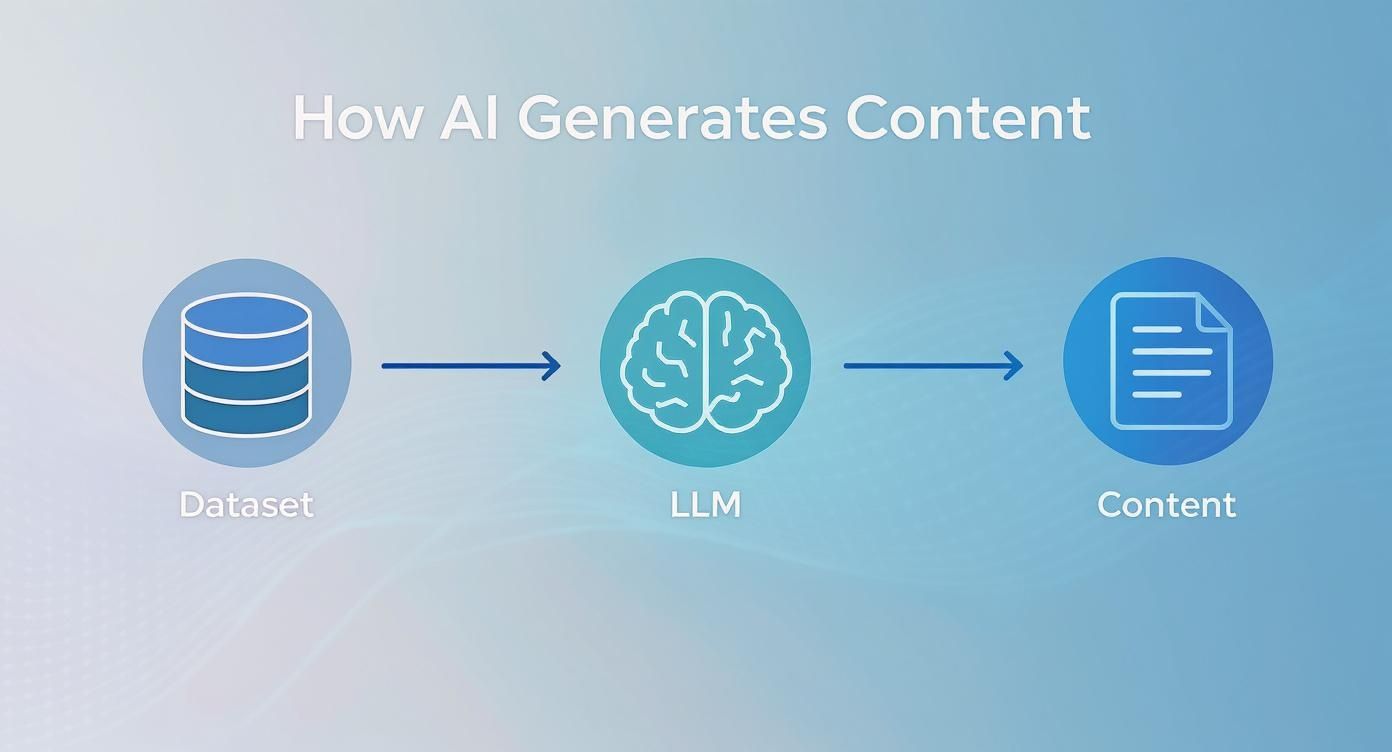
This diagram makes it clear: the better the data and the more advanced the AI model (the LLM), the better your final output will be.
Manual vs AI Powered Content Creation Workflows
To really appreciate the difference, let's compare how long common tasks take with and without AI. The time savings are staggering and free up your team for more strategic work.
| Content Task | Manual Workflow (Est. Time) | AI-Assisted Workflow (Est. Time) | Primary AI Advantage |
|---|---|---|---|
| Blog Post (1,500 words) | 6–8 hours | 1–2 hours | Rapid drafting and research |
| Social Media Calendar (1 Week) | 3–4 hours | 30 minutes | Content repurposing and scheduling |
| Email Newsletter | 2–3 hours | 20 minutes | Subject line and copy generation |
| Product Descriptions (10) | 4–5 hours | 45 minutes | Consistent tone and scale |
| Video Script (2 minutes) | 2–4 hours | 15 minutes | Ideation and structural outlining |
As the table shows, AI doesn't just make you faster; it completely redefines what's possible in a workday.
Scale Your Output Without Scaling Your Budget
For most businesses, pumping out more content used to mean one thing: hiring more people. AI-powered content creation completely flips that script. Now, a lean team can generate the volume of a much larger department.
This is a game-changer. Suddenly, you can experiment with new formats or create highly personalized content for different audience segments without a massive budget commitment. The ability to scale social media, in particular, has led to a new class of specialized AI social media post generator tools.
This kind of growth is why the market for these tools is exploding. Valued at USD 54.28 billion in 2024, it's projected to hit a massive USD 222.72 billion by 2032.
Amplify Your Creative Potential
One of the biggest myths about AI is that it kills creativity. Nothing could be further from the truth. Used correctly, AI is an incredible brainstorming partner that can push you in directions you’d never have thought of on your own. It can analyze huge datasets to spot fresh angles, find niche topics, and draw connections you might have missed.
Think of AI as your creative sidekick that’s always on and never runs out of ideas. It does the heavy lifting on brainstorming, freeing you up to focus on refining the best concepts and injecting your own unique voice and expertise.
This collaborative approach is the key to a modern, high-efficiency content creation workflow. The AI provides the raw material, and your human touch turns it into something truly great. You offload the grunt work and get back to what matters most: strategy, storytelling, and real innovation.
Real-World Examples of AI Content Creation in Action
It’s one thing to talk about what AI can do, but it’s another thing entirely to see it working in the real world. Across every industry, people are using AI tools to get work done faster, break through creative blocks, and solve problems that used to take weeks or months.
Let's look at a few examples of how this is actually playing out.

This isn't just a niche trend; it's a massive shift. The AI content creation market was valued at USD 2.15 billion in 2024. Projections show it rocketing to USD 10.59 billion by 2033, growing at an explosive annual rate of 19.4%. If you want to dig into the numbers, you can read the full analysis on this market expansion.
How Marketing Teams Are Supercharging Their Campaigns
A mid-sized marketing agency was hitting a familiar wall. They needed to crank out high-quality blog posts and endless ad variations for clients, but their team was stretched thin. Too much time was spent just getting a first draft on the page, leaving little room for the strategic work that actually gets results.
By bringing an AI content tool into their process, they completely changed the game. Instead of staring at a blank page, they now use AI to generate multiple blog outlines and rough drafts based on keywords. For ad campaigns, they can spit out dozens of A/B test variations in minutes.
The result? They cut their content production time by 40%. Their team was freed up to focus on what matters: optimizing campaigns, talking to clients, and thinking strategically.
Key Takeaway: AI turns content creation from a slow, manual chore into a high-speed strategic operation. It does the heavy lifting, so your experts can focus on adding the polish and creative spark.
How E-commerce Brands Are Scaling Product Descriptions
Picture an online store with 5,000+ products. Writing a unique, compelling, and SEO-friendly description for every single one is a soul-crushing task. More often than not, it leads to generic copy that bores customers and gets ignored by Google.
This retailer used an AI platform to automate the entire process. They fed the AI product specs—materials, dimensions, key features—and defined their brand's voice. The AI then churned out thousands of unique, engaging descriptions.
Not only did this save an incredible amount of time, but it also boosted organic traffic to product pages by 15% and led to a real lift in sales. Each description was written to sell, highlighting what made each product special.
How Corporate Training Gets Done in Record Time
A large company needed to create a whole new set of training modules for its sales team. The learning and development department was small, and building courses, lesson plans, and quizzes from scratch was painfully slow.
They turned to AI to accelerate everything. The team gave the AI the core topics and goals, and it quickly generated detailed course outlines, drafted the content for each lesson, and even created a bank of quiz questions.
Using this AI-assisted workflow, the team built the entire training series in just one month—a project that would have easily taken them a full quarter before. Knowing which platform to choose is crucial, and our guide on the best tools for content creation can help you sort through the options.
These examples make it clear: AI powered content creation isn't some far-off idea. It's a practical tool that’s here today, helping professionals work smarter, faster, and more creatively in just about every field you can imagine.
Best Practices for High-Quality AI Content
Just hitting the "generate" button and hoping for the best won't get you very far. The real magic of ai powered content creation happens when human expertise guides the technology.
Think of an AI tool not as a vending machine for articles, but as a brilliant junior assistant—fast and full of potential, but needing your direction to truly shine.
That’s why a "human-in-the-loop" approach isn't just a good idea; it's essential. This philosophy puts you, the creator, right at the center of the process. You're the strategist, the editor, and the final quality check, ensuring every piece of content is accurate, original, and genuinely valuable.
Master the Art of the Prompt
The quality of what you get out of an AI is a direct reflection of what you put in. Vague instructions lead to generic, forgettable results.
This is where prompt engineering becomes your most valuable new skill. A great prompt is like a detailed creative brief for your AI assistant, telling it exactly what you need and how you want it done.
To get beyond basic commands, you need to give the AI more to work with. A structured prompt helps the AI understand the what, why, and how behind your request.
Prompting Framework for Better AI Outputs
Here’s a simple but powerful framework to guide the AI toward producing higher-quality, more relevant content.
| Component | Purpose | Example |
|---|---|---|
| Role | Assigns a persona to the AI. | "Act as an expert B2B SaaS marketer..." |
| Task | Clearly defines the objective. | "...write a 500-word blog post introduction." |
| Format | Specifies the desired structure. | "Include a hook, a problem statement, and a solution teaser." |
| Constraints | Sets boundaries or rules. | "Avoid jargon. Write in an active voice. Keep paragraphs short." |
| Context | Provides necessary background info. | "The target audience is startup founders with limited marketing budgets." |
Using a detailed framework like this transforms your requests from simple questions into powerful directives, dramatically improving the AI's first draft.
Edit and Fact-Check Relentlessly
An AI-generated draft is a starting point, not a finished product. It’s an incredible time-saver, but it still needs your critical eye to meet professional standards.
Remember, AI models can sometimes "hallucinate"—producing information that sounds plausible but is completely wrong. It's your job to verify every claim, statistic, and fact before you hit publish.
Treat every AI-generated draft with healthy skepticism. Your expertise is what adds the layers of accuracy, nuance, and trustworthiness that build a loyal audience. Never publish raw, unedited AI output.
Your editing process should focus on a few key areas:
- Accuracy: Double-check all data points and factual statements against reliable sources.
- Originality: Run the final piece through a plagiarism checker to ensure it’s unique.
- Brand Voice: Tweak the text until it perfectly matches your brand’s tone and style.
- Human Touch: Inject your unique perspective, add personal stories, and refine the narrative to truly connect with your readers.
Uphold Ethical Guardrails
As ai powered content creation becomes more common, operating ethically is critical for maintaining trust with your audience.
Always be transparent about your use of AI when it makes sense. You don't need a disclaimer on every social media post, but for more substantial work, it can build credibility.
Most importantly, remember that you are responsible for the content you publish. If an AI generates something inaccurate or harmful, the buck stops with you, not the tool. This reality is why the human-in-the-loop approach is so non-negotiable.
To dig deeper, explore our detailed guide covering content creation best practices for modern creators. By mastering these principles, you can ensure AI serves as a powerful and reliable partner in your creative process.
The Future of Content and AI
After diving deep into the world of AI-powered content creation, one thing is crystal clear: this isn’t just another trend. It’s a fundamental shift in how we build and share ideas. From the basics to the pro-level techniques, it’s obvious that AI works best as a creative partner, amplifying our own skills instead of trying to replace them. The main takeaway is simple—your expertise, when paired with smart technology, gets you better results, and gets them faster.
Looking ahead, the road is even more exciting. The tech is quickly evolving past basic text generation and moving toward a future that's more integrated, intelligent, and frankly, more intuitive.
Emerging Trends to Watch
The next wave of AI will feel less like a tool you open and more like an invisible assistant baked into everything you do. Get ready for a world where content becomes incredibly personal and creation itself breaks out of its traditional boxes.
Three major trends are bringing this new reality to life:
- Hyper-Personalization: Think about AI crafting a unique content experience for every single person who interacts with it. We're talking about blog posts that change their examples based on a reader’s job title, or ad copy that adjusts its tone based on how someone has engaged with your brand before.
- Seamless Integration: AI tools will increasingly disappear into the platforms you already use every day, like your CMS or design software. This cuts out the friction, making intelligent help a completely natural part of how you work.
- Multi-Modal Generation: The walls between text, images, and video are crumbling. Soon, you'll be able to give a single command and have an AI write an article, design custom graphics to go with it, and even draft a video script based on the whole package.
Embracing AI isn't about chasing the next shiny object; it’s about adopting a smarter, more efficient way to create. Yes, there's a learning curve, but the opportunity for creators to scale their impact has never been bigger.
This future isn't a threat to creativity—it’s an open invitation to achieve more than you ever could before.
Got Questions About AI Content? We've Got Answers.
Jumping into AI-powered content creation is exciting, but it naturally brings up a few questions. This is a new way of working, and it's smart to think about everything from SEO to originality. Let's tackle some of the most common uncertainties so you can move forward with confidence.
These aren't just abstract ideas—they're the practical hurdles every modern creator runs into. Getting these answers straight is the first step to using AI tools the right way.
Can AI-Generated Content Actually Rank on Google?
Yes, it absolutely can. Google has made it crystal clear: they reward high-quality, helpful content that serves the user, no matter how it was made. The old myth that all AI content gets automatically penalized is officially dead.
Forget about the tool and focus on the result. The real key is producing content that hits all the marks for E-E-A-T (Experience, Expertise, Authoritativeness, and Trustworthiness). If your final article is valuable, well-researched, and nails what the user is looking for, it has every chance to rank. The human touch—your editing, fact-checking, and unique insight—is what gets it there.
Is Using AI for Content Creation Plagiarism?
No, when used correctly, it's not plagiarism. Generative AI models are built to create entirely new text by recognizing patterns in massive amounts of data. Plagiarism is lifting someone else’s work and passing it off as your own without credit. These are two very different things.
But this comes with a huge responsibility. You are the publisher, and it’s on you to make sure the final piece is original.
Always fact-check what an AI gives you. Then, edit it to inject your own perspective, stories, and brand voice. Think of the AI's draft as raw clay—your expertise is what shapes it into a polished, unique final product that is 100% yours.
That human oversight isn't just a suggestion; it's essential for maintaining originality and quality.
What’s the Best Way to Get Started with AI Tools?
The smartest way to begin is to start small. Don't try to write a 5,000-word masterpiece on day one—that's a recipe for feeling overwhelmed. Instead, pick one specific, nagging task in your current workflow and let AI take a crack at it.
This method lets you learn the ropes without blowing up your whole process. You'll see an immediate win, build confidence, and start seeing other ways AI-powered content creation can fit into your day-to-day work.
Here are a few easy places to start:
- Brainstorming Blog Titles: Ask the AI for 20 creative headlines for your next post.
- Drafting Social Media Posts: Get five different versions of a tweet to promote your latest article.
- Creating an Outline: Give your topic to the AI and have it map out a detailed outline with all the key talking points.
By knocking out these smaller, often repetitive tasks first, you build momentum. The goal isn't to make your job more complicated; it's to make it easier.
Ready to create stunning visuals for your content in seconds? AI Media Studio empowers you to generate professional-quality images from simple text prompts, with over 50 art styles to choose from. Start for free and see how easy it is to elevate your visual content.